
BRAZIL: Murder of indigenous child provokes reaction

By Global Voices
This post is part of our special coverage Indigenous Rights.
The murder of an eight year old child from the Awa-Gwajá indigenous community, allegedly burnt alive [pt] by loggers in the state of Maranhão, Brazil, has caused outrage throughout the Internet, as well as disbelief by many in the face of such cruelty.
The Indigenous Missionary Council (CIMI) confirmed [pt] that “suspicions indicate that an attack has occurred between September and October against the camp of isolated indigenous” of the Araribóia reserve, and added more information:
The charred body was found in October 2011 in a camp abandoned by the isolated Awá, about 20 km from the Patizal village of the Tenetehara people, a region located in the municipality of Arame (Maranhão). The National Indian Foundation (FUNAI) was informed of the incident in November and no investigation of the case is ongoing.
According [pt] to Rosimeire Diniz, CIMI’s coordinator in Maranhão state, “the situation has been reported for a long time. It has become a frequent occurrence, the presence of these logging groups, putting the isolated indigenous in danger. No concrete measure has been taken to protect this population”.
“The world needs to know”
Journalist Eliano Jorge interviewed [pt] a Guajajara Indian who said:
[…] The loggers were buying wood from the hands of the Indians (Guajajara) and found a little Gwajá girl. They burned the child. Just to be evil. She is from another tribe, they live in the woods, have no contact with whites, are polecats.
Journalist Luis Carlos Azenha, on the other hand, urged caution [pt]:
Renato Santana [press officer of CIMI] denied the existence of any photo of the charred body. Only an official investigation led by Funai can confirm if that in fact there is a charred body and if in fact is a child. Moreover, it takes the direct testimony of someone who witnessed the episode to see if there was a crime and, if any, to identify the perpetrators.
To which journalist Niara de Oliveira replied [pt], raising the issue of reported unofficial coallitions between “FUNAI officials in the region of Arame [and] local ranchers and loggers”:
“it is therefore not surprising that there is no ongoing investigation and that the case has only now come to light.” Based on the behavior of the federal government to investigate the murder of the Guarani chief in the state of Mato Grosso do Sul and the importance they give to indigenous people when it comes to benefitting allies (contractors, large farmers, loggers, lumbermen, etc.) and based on the importance that the government-friendly press gives to the indigenous people themselves, I tend to rely on Rogérios’ investigation.
Rogério Tomaz Jr, born in Maranhão, was the first to report the case in the blogosphere; he ironically posted the various hypotheses about the case that have emerged, especially those that accuse the indigenous and social organizations of lying and fabricating a story. He criticizes the expected media silence about the case, and affirms [pt] with disgust that if an Indian slapped a logger or a farmer in the face there would be plenty of editorials.
Anthropologist Uirá Garcia, quoted by ISA (Socio-Environmental Institute) on its Facebook page, said [pt] that “there are indications that a Guajá Awa child of the group living in seclusion at the indigenous reserve of Araribóia, has vanished from her small group that encountered a group of loggers, months ago”:
The Guajajara [one of the most numerous indigenous people of Brazil] who found the body, reported the incident to Funai, but nothing was done. This information was already known by some people linked to the indigenous peoples of the state of Maranhão for at least two months, however, by the lack of more concrete evidence, [the fact] had not yet been disclosed. And now, it seems that the information (which may indeed be true) “leaked” onto the Internet.
Doctor, Diana Serra, has urged [pt] revolt in reaction to the news:
Look how far the violence is going in our state of Maranhão. And the government does nothing, representatives of the Justice do nothing. The representatives of the people do nothing. […] We must let the world know what happens in Maranhão. Land without law to holders of money and power. Some, true marginal, where still resists the coronelismo [the rule of hereditary elites].
Persecution of indigenous peoples
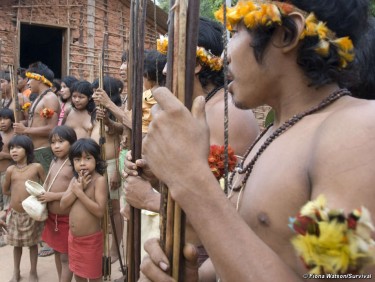
The Awá, a term meaning “man” or “person”, are, according to the organization Survival International, “one of only two nomadic hunter-gatherer tribes remaining in Brazil”:
Some are uncontacted, ranging from tiny family groups who are on the run, living in the last fragments of Maranhão’s rapidly dwindling rainforest outside legally recognized territories, to approximately 60 individuals living in the Araribóia reserve which is heavily invaded by illegal loggers.
In 2008, a seven year old Guajajara child was killed [pt] with a shot by a motorcyclist in the town of Arame and other indigenous ethnic groups were also victims of similar violence, and rape, in the region. Violence against the indigenous population in Brazil has spread and taken on alarming proportions.
The ongoing genocide against the Guarani-Kaiowá in the state of Mato Grosso do Sul has been receiving increasing attention in the alternative media, especially in the blogosphere, but it is still a forbidden subject in the mainstream media. The Brazilian federal government, too, has taken no steps to publicize the crimes, and especially to prevent further deaths.
Other traditional populations are also victims [pt] of the violence [pt], committed largely by the federal government – or through its silence, which uses the military to intimidate Quilombolas traditional black populations and expel them from their lands. The construction of the Belo Monte Dam is another serious threat to the survival of entire indigenous communities in the Amazon region.
Another danger that presents itself to the indigenous and traditional populations of Brazil is the possible approval of the new Forestry Code, presented by Communist politician Aldo Rebelo, in conjunction with the ruralist leader Katia Abreu, and that is being contested by environmentalists and activists from different areas.
Journalist Lucão, recalling the recent case in which two activists of the state of Para, José Claudio Ribeiro da Silva and Maria do Espirito Santo da Silva were “cowardly killed by loggers”, as reported by Global Voices in May 2011, is another one to show revolt [pt] over the atrocity against the Awá:
As if it wasn’t enough, the brutal assault that loggers constantly promote in northern Brazil against our flora and fauna – because cutting down trees, birds and animals are attacked directly – it has now descended into crude cowardice of atrocious criminals linked to figures ignoring the forest life and human life.
Journalist Carlos Hermes, astonished, asks himself [pt] how long such atrocities will be tolerated:
[…] imagine how many atrocities are committed by these monsters in the middle of the dispute for virgin forest to be cleared and sold by them? Indian history is a hindrance to these frontier thugs that destroy the greatest wealth of Brazil. We experienced this for more than 500 years and the inoperative and conniving state watches as if it condoned [the incidents as] trivial. Until when? Will [they] get away [with it]?
By Raphael Tsavvko Garcia in Global Voices.